Clear facts, calm guidance, and how luxury villas are adapting to a changing climate
The calm before the questions
Each year, travelers glance at the calendar and notice a familiar question arise: “Is Cabo safe during hurricane season?”
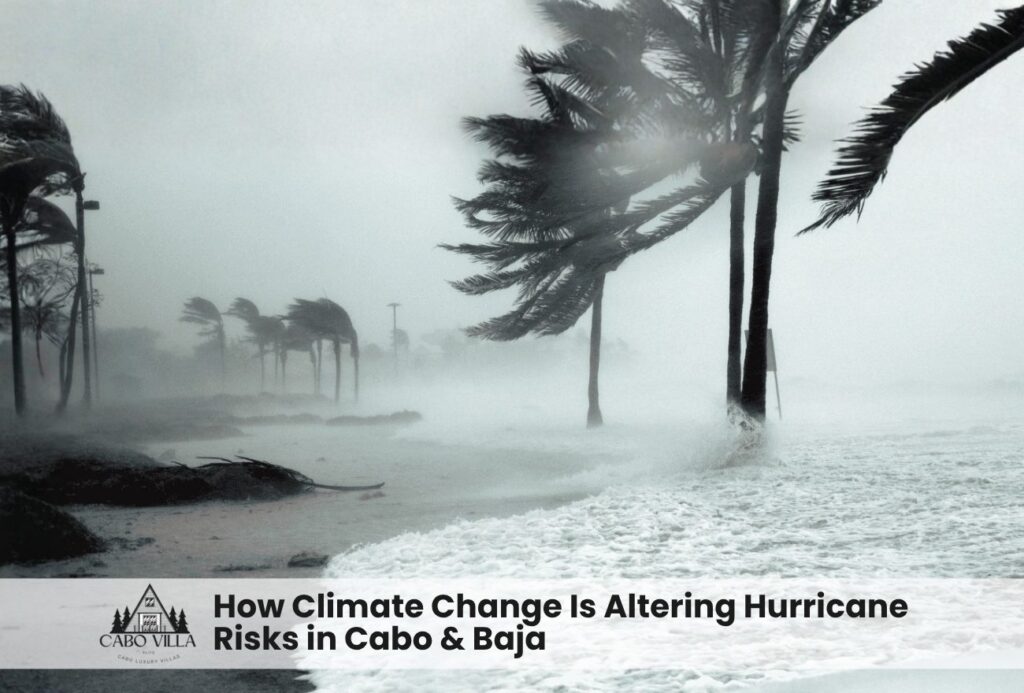
They’ve seen photos of brilliant blue skies turning grey, or headlines about tropical storms swirling across the Pacific. Yet, on most days, Cabo San Lucas remains sunny, warm, and perfectly still.
But as climate change reshapes the world’s oceans and weather patterns, hurricane behaviour in Baja California Sur is also shifting—slowly, subtly, but noticeably.
Understanding these changes helps visitors plan smarter, and it gives property owners the insight to design villas that stay beautiful and resilient.
Let’s explore how global warming is influencing the hurricane season in Cabo, what’s truly changed (and what hasn’t), and how high-end villas are preparing so guests can travel with confidence.
Hurricane season in Cabo — the months that matter
Officially, the Eastern Pacific hurricane season runs from May 15 to November 30.
For most of that time, Cabo enjoys calm weather—gentle winds and brilliant sunshine—but the peak storm activity usually comes between September and early October.
On average, only a few tropical systems each decade directly affect Cabo San Lucas. Most curve westward into the open Pacific before ever reaching land. Still, during the warmest months, sea-surface temperatures climb high enough to fuel storms farther north than before—a trend scientists are now studying closely.
Quick facts:
- Peak risk: Mid-August – early October
- Least risk: December – May
- Average rainfall: Highest in September
- Primary driver: Warm ocean water (> 26 °C / 79 °F) combined with favourable wind shear
In other words, hurricane season isn’t a constant threat; it’s a window of potential. Most days remain perfect for the beach.
What climate change is changing (and what it isn’t)
The phrase “climate change” often brings to mind chaos—but when it comes to tropical cyclones, the science paints a nuanced picture.
1. Stronger rainfall and wetter storms
Warmer air holds more moisture—roughly 7 percent more per °C of warming. That means when a storm does form, it can release heavier rainfall over a shorter time.
For Baja, this translates to localized flooding rather than more frequent hurricanes. Villas positioned on higher ground or designed with advanced drainage are far less affected.
2. A higher share of intense hurricanes
The number of tropical cyclones each year in the Eastern Pacific hasn’t significantly increased.
However, studies suggest the proportion of Category 3–5 storms is slowly rising, and these storms can also intensify more rapidly (a process known as Rapid Intensification).
In practical terms: Cabo is still hit rarely, but when storms approach, they may strengthen faster than they did decades ago.
3. Shifting tracks and subtle northward movement
Some research indicates that the peak latitude of hurricane intensity has crept poleward—meaning strong storms are occurring slightly farther north. For Baja, this could increase occasional exposure on southern coasts, though changes remain small compared to the natural year-to-year swings caused by El Niño and La Niña.
4. What’s not changing
Cabo’s desert climate, topography, and offshore currents still create natural protection.
Most hurricanes weaken rapidly once they near land or encounter cooler water near the peninsula.
In short: storms remain possible, but the overall risk remains moderate and well-managed.
Rapid Intensification the new buzzword for forecasters
In the last decade, meteorologists have observed a rise in storms that intensify by more than 35 mph (55 km/h) in under 24 hours—a phenomenon called Rapid Intensification (RI).
For travelers, this doesn’t mean more danger—it simply means forecasts can change quickly. A system that looks weak in the morning may be a hurricane by the next day.
That’s why luxury villas and resorts in Cabo monitor the National Hurricane Center’s (NHC) Eastern Pacific Outlook daily during the season.
Guests typically receive updates only if a system is projected within the 5-day cone, giving them peace of mind that professionals are tracking conditions long before there’s any risk.
Traveler takeaway:
Check the NHC EPAC map or NOAA’s hurricane outlook 48 hours before your flight. If there’s no named storm nearby—and there usually isn’t—you’re perfectly fine.
El Niño & La Niña the hidden influencers
The El Niño–Southern Oscillation (ENSO) controls much of the Pacific’s storm rhythm:
- During El Niño, warm surface waters spread eastward across the Pacific, fueling more frequent and sometimes stronger storms off Mexico’s coast.
- During La Niña, cooler water and stronger wind shear usually suppress storm formation in the region.
For example, 2014’s El Niño conditions helped power Hurricane Odile, one of Cabo’s strongest modern storms. By contrast, La Niña years often pass with barely a tropical depression nearby. This cyclic pattern reminds us that not every “climate signal” is permanent—some years will always be calmer than others.
A look back: Cabo’s major hurricanes and lessons learned
Hurricane Odile (2014)
Odile remains the defining modern benchmark. It struck near Cabo San Lucas as a Category 3 storm with sustained winds around 125 mph.
Hotels and villas sustained damage, but reconstruction began almost immediately. Within months, new building codes required:
- Impact-resistant glass
- Stronger roof tie-downs
- Backup power standards
- Enhanced drainage systems
Hurricane Norma (2023)
Norma reached Cabo as a Category 1, mainly bringing heavy rain and power outages—but also demonstrated how well Cabo’s updated infrastructure performs.
Flights resumed within days, and major resorts reported minimal structural damage.
Historical context
Long-term records show that direct hurricane landfalls in Cabo average roughly one per decade.
It’s not a yearly event—more a rare but well-planned-for occurrence.
How luxury villas in Cabo are adapting
The best luxury villas in Baja don’t just chase ocean views—they’re engineered for resilience.
Here’s how high-end properties safeguard guests and maintain operations even when nature tests them.
1. Design and construction
- Impact-rated windows and doors that meet Miami-Dade wind standards
- Concrete or steel-reinforced roofing instead of light tiles
- Drainage channels and slope grading to divert water away from living spaces
- Elevated foundations for ocean-front lots to minimize flood exposure
- Storm-resistant landscaping with deep-rooted native plants to prevent erosion
2. Backup infrastructure
- On-site generators and water storage for temporary outages
- Dedicated communications systems (satellite Wi-Fi or radios) for updates
- Solar + battery systems to maintain essential power even if the grid fails
3. Operations and guest communication
- Villas follow five-day monitoring protocols during storm watches.
- Guests receive concise updates: travel advisories, airport status, safety steps.
- Pre-prepared shelter-in-place areas stocked with food, water, and lighting.
4. Booking transparency
- Flexible policies allow rebooking or credit if an NHC watch/warning is issued during stay dates.
- Guests are advised to carry Cancel For Any Reason (CFAR) travel insurance covering weather disruptions.
For travelers, this means even if the skies shift, comfort and safety remain consistent.
Planning a Cabo villa trip during hurricane season
Travel during storm months isn’t something to fear—it simply requires awareness.
Below are practical steps luxury travelers follow for stress-free planning.
Before booking
- Choose villas with published hurricane-readiness plans.
- Ask about elevated locations and backup power systems.
- Confirm flexible cancellation policies tied to NHC alerts.
- Purchase travel insurance that covers hurricanes and flight delays.
Two weeks before travel
- Monitor NOAA’s Eastern Pacific Outlook once or twice weekly.
- Check local forecasts via Protección Civil Baja California Sur or the U.S. Embassy Mexico alerts.
- Ensure your airline’s app notifications are enabled for schedule changes.
Day of travel
- Review the five-day forecast cone—most storms are visible long before you fly.
- Pack light emergency essentials: a small power bank, flashlight, waterproof pouch for documents, and any essential medication.
During your stay
- Follow villa staff guidance—they’re trained and connected to local authorities.
- Avoid swimming during red-flag surf advisories.
- If a watch is issued, stay indoors until it passes. Cabo’s modern villas are designed for this.
Climate change, resilience, and Cabo’s future
What does the next decade look like?
Climate projections suggest:
- Average hurricane counts will stay similar, but Category 3-5 events could become 10–20 % more frequent globally.
- Rainfall extremes may intensify, making drainage and runoff systems more crucial.
- Sea levels could rise a few centimetres by 2035, slightly increasing coastal surge potential.
Yet Cabo has responded decisively:
- New coastal zoning rules require higher construction elevations.
- Resorts and villa communities share weather data with civil protection teams.
- Power and communication grids are being upgraded with underground lines.
Rather than being “at risk,” Cabo is becoming a model for climate adaptation in Mexico’s luxury tourism sector.
Live resources to track hurricane updates
Bookmark these before your trip:
| Purpose | Resource | Link |
|---|---|---|
| Official forecasts | NOAA / NHC Eastern Pacific Outlook | hurricanes.gov |
| Local alerts | Protección Civil Baja California Sur | bcs.gob.mx/proteccioncivil |
| Scientific background | NOAA Tropical Climatology Portal | oceanservice.noaa.gov |
| U.S. traveler updates | U.S. Embassy Mexico Weather Alerts | mx.usembassy.gov |
| ENSO updates | NOAA Climate Prediction Center ENSO | climate.gov |
These are the same sources used by resorts and aviation authorities to make decisions—so they’re as reliable as it gets.
FAQs
When is hurricane season in Cabo?
From May 15 to November 30, with most activity from September to early October. The rest of the year is extremely stable.
Are hurricanes becoming more common in Baja?
Not necessarily more frequent, but heavier rainfall and faster-strengthening storms are now more likely during warm years.
Does El Niño mean a dangerous season?
El Niño years often bring more Eastern Pacific storms, but only a few ever reach Cabo. Checking forecasts before travel is usually enough.
Is Cabo safe to visit in September?
Yes—provided you stay in villas with modern safety standards and remain flexible with dates if advisories arise.
What did Hurricane Odile change?
Odile (2014) led to stronger building codes, better drainage, and stricter readiness protocols—improvements that make Cabo safer today.
Should I buy travel insurance for hurricane season?
Absolutely. Look for policies that cover weather-related cancellations and trip interruptions, especially CFAR options.
Final word: knowledge over fear
Hurricanes season in Cabo have always been part of life on tropical coasts—but knowledge turns risk into readiness.
For most of the year, Los Cabos remains the sun-drenched retreat travelers dream of.
When nature occasionally stirs, the community’s preparation ensures that visitors stay protected, informed, and comfortable.
So when you plan your next escape, remember:
Luxury in Cabo isn’t just comfort—it’s confidence built to weather any season.