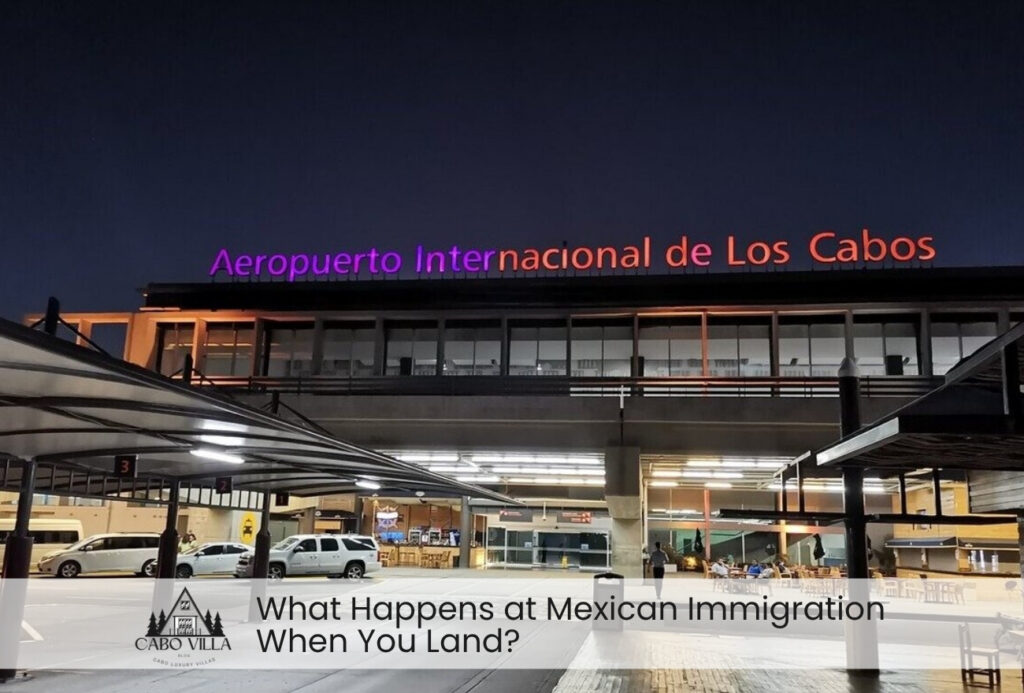
You just touched down at Los Cabos International Airport. The plane doors open, the Baja sun is waiting somewhere on the other side of the terminal, and you have absolutely no idea what comes next. That feeling of uncertainty right after landing is more common than you think, and it is entirely avoidable.
This guide walks you through every single step of the Mexican immigration and customs process, written specifically for travelers flying into SJD. No vague advice. No recycled checklists. Just the real sequence of what happens, in order, so your arrival is as smooth as the villa stay you have already planned.
If you have not yet settled on where you are staying, reading about villas in Cabo with a private chef will show you exactly why so many visitors skip resorts and go straight to a private villa experience.
The Moment You Step Off the Plane
After your aircraft parks at the gate, follow the signs toward immigration. At SJD, the terminal layout is compact compared to airports like Mexico City or Cancún, so the walk from the jet bridge to the immigration hall is short. Keep your passport in your hand before you even reach the queue. That small habit saves you two minutes of fumbling and a lot of impatient looks from the people behind you.
Passport Control: What the Officer Actually Checks
This is the first official stop.
You will stand in line and approach an immigration officer at a booth. The officer works for Mexico’s National Institute of Migration, known locally as the INM (Instituto Nacional de Migración). Their job is to verify your identity, confirm your nationality, and determine how long you are permitted to stay in the country.
Hand over your passport and say nothing beyond a polite greeting. The officer will scan your document, look at your face, and in most cases stamp your passport within thirty seconds.
The stamp itself is what matters. It grants you entry and shows the number of days you are authorized to remain in Mexico. That number is at the officer’s sole discretion. The upper limit for tourist stays is 180 days, but receiving that full allowance is no longer automatic. Some travelers in 2025 and 2026 have reported receiving 30, 60, or 90 days depending on what they present and how they answer questions. If you are planning a longer trip, carry proof of your accommodation booking and a return flight. Presenting those documents at the booth, even without being asked, signals to the officer that your stay is well-defined and your intention is tourism.
Your passport must be valid for at least six months beyond your planned date of entry. If you are traveling with children who are not accompanied by both parents, carry a notarized letter of permission from the absent parent. Mexican immigration takes the documentation of minors seriously.
The FMM Tourist Card: Is It Still Required?
This is where most travelers get confused, because the answer changed a few years ago and information online has not fully caught up.
The FMM, the Forma Migratoria Múltiple, was the paper tourist card that visitors used to fill out on the plane. You would hand it to the immigration officer at arrival, and they would stamp it and return half of it to you for safekeeping.
At major international airports, including Los Cabos, Mexico has moved to a digital entry system for most tourist arrivals. Your entry is now recorded electronically and linked directly to your passport number. The physical paper card is largely no longer required for tourists arriving by air on a commercial flight.
That said, the situation varies. Some airports still issue paper forms in specific cases. Some travelers from certain countries or with certain visa categories may still receive a physical document. If an officer or airline crew member hands you a form on the flight, fill it out completely and keep it with your passport. Do not toss it in the seat pocket and forget it.
If you do receive a stamped document at immigration, keep it for the entire trip. You may be asked to present it when you leave Mexico.
Automated E-Gates: The Fast Lane You Should Know About
Several Mexican airports, including SJD, have introduced automated e-gates for eligible travelers. These are self-service kiosks that scan your biometric passport, take your photo, and process your entry digitally.
If you hold a US, Canadian, UK, or EU passport, are traveling alone as an adult, and are not entering as a resident visa holder, you may be directed toward an e-gate lane. The process is fast, often under two minutes, and significantly shorter than the staffed counter line during peak arrival periods.
Not all travelers will be eligible, and the lanes are not always operational. If you are directed to a staffed counter instead, that is completely normal and not a cause for concern.
Baggage Claim
After immigration clears you, follow the overhead signs to baggage claim. Screens throughout the hall will display which carousel corresponds to your flight number. At SJD, the baggage area is straightforward to navigate and carousels are labeled clearly.
Collect all of your bags before moving toward customs. Do not head to the exit without everything, because once you enter the customs inspection zone you cannot go back to the carousel.
While you are waiting for your bags, this is a good moment to confirm your ground transportation. If you booked a luxury villa stay in Los Cabos, your host or villa concierge will typically arrange a private transfer from the airport directly to your property. Having that confirmation pulled up on your phone saves time once you exit.
Mexican Customs: The Red Light Green Light System
After collecting your luggage, you pass through customs. This is the final official checkpoint before you walk out into the arrivals hall.
You will approach a customs officer and hand over your customs declaration form. This form is typically distributed on the plane during the flight. If you did not receive one, there are blank forms available near the customs counters. Families traveling together fill out a single form per household group, not one per individual.
The form asks whether you are carrying goods beyond the personal allowance. For air travelers, Mexico’s duty-free general merchandise limit is $500 USD worth of goods. Personal belongings like clothing, toiletries, and personal electronics are not counted against this limit. Adults may bring three liters of alcohol and either 200 cigarettes or 50 cigars. If you are over the limit or carrying something that must be declared, mark it on the form and pay the applicable duty at the counter. The penalties for not declaring and getting caught are steep.
After you hand over your form, the officer will ask you to press a button on a small electronic device that resembles a traffic light. This is Mexico’s randomized customs screening system.
Green light means you pass through without inspection.
Red light means your luggage will be searched by a customs agent. The inspection is usually brief. The agent checks for prohibited or undeclared goods, confirms your form, and waves you through.
The system is genuinely random. Neither looking confident nor having only one small bag guarantees green. Just be honest on your form, stay calm, and move through when directed.
One item worth flagging in 2026: vaping devices and electronic cigarettes are fully banned from import into Mexico. Carrying them, even as personal use items, can result in confiscation and fines. Leave them at home.
If you are planning to exchange currency once you clear customs, you will find exchange windows and ATMs inside the terminal near the arrivals exit. The Cabo currency guide breaks down where to get the best rates in Los Cabos and whether it makes more sense to exchange before your trip or at the airport.
What Happens If You Get Extra Scrutiny
Secondary screening is not common for leisure tourists, but it happens. If an officer asks you to step aside for additional questions, stay calm and answer directly.
They may ask about the purpose of your trip, where you are staying, who you are traveling with, or how long you plan to be in Mexico. Having your accommodation confirmation, return flight details, and travel insurance documentation on hand answers most questions before they are even asked.
If your passport has a valid visa or residency stamp for Mexico, show that page immediately when you approach the booth. Failing to present your residency status upfront can result in being processed as a regular tourist, which creates complications when you later need to renew or transition your status.
The Gauntlet After Customs
You pass the customs checkpoint. You are now legally in Mexico. Congratulations.
Before you reach the exit doors, you will walk through a wide corridor lined with counters on both sides. People behind these counters will call out to you, wave brochures at you, and offer time-shares, resort packages, discounted tours, and transportation deals. Some are legitimate local businesses. Many are high-pressure sales operations.
You are not required to stop. You are not required to take anything from them. A polite “no, gracias” as you walk toward the exit doors is entirely sufficient. Keep moving.
Getting to Your Villa From SJD
Once through the arrivals door, you enter the main terminal lobby. This is where ground transportation options wait.
Official airport taxis operate from a designated stand outside. The ride from SJD to Cabo San Lucas takes between 35 and 50 minutes depending on traffic. Shared shuttles are cheaper and take longer due to multiple stops at different hotels and resorts.
If you have arranged a private villa stay, a pre-booked private transfer is the cleanest option. No waiting at taxi ranks, no sharing a van with strangers, and your driver will typically hold a sign with your name in the arrivals area. If you are heading to one of the Cabo resorts along the beachfront corridor, confirm your transportation method with the property in advance so there is no confusion at the pickup point.
Before You Land: The Smart Preparation Checklist
The immigration process at SJD moves quickly when you are prepared. The people who slow down the line, and occasionally get pulled aside for extra screening, are usually the ones who show up unprepared rather than those with something to hide.
Passport validity confirmed for at least six months beyond your travel dates.
Return or onward travel booked and accessible on your phone.
Accommodation confirmation saved offline in case you have no signal.
Customs declaration form filled out truthfully before you reach the checkpoint.
No vaping devices, e-cigarettes, or fresh produce in your luggage.
If you are heading to a vacation villa for a family trip or a group getaway, arriving organized makes the entire journey better. Understanding what horseback riding on the beaches near Cabo or hiking Fox Canyon and the Sol de Mayo waterfall looks like before you land gives you something real to look forward to while waiting in the immigration queue.
Your First Hours in Los Cabos
The immigration process is quick. The customs process is quick. Even on a busy travel day, most tourists are through both checkpoints and standing outside the terminal within 45 minutes of landing at SJD.
What comes after is the part worth focusing on. The Baja Peninsula has a different pace than most places. The light looks different. The air off the Sea of Cortez smells like salt and desert. The road south from the airport to Cabo San Lucas runs along a coastline that gives you your first real glimpse of why people keep coming back here.
If you are still in the planning phase and trying to understand what kind of accommodation actually fits your group, the about page for Cabo Luxury Villa explains exactly how the site works and what makes private villa stays in this part of Baja different from a standard hotel or resort booking.
Land well. Clear quickly. The rest of the trip takes care of itself.